
Random Forest: Interview Questions & Answers
Medium-to-Hard Concepts Explained the Way Interviewers Expect

Introduction
Random Forest is one of those algorithms that looks deceptively simple on the surface but reveals a surprising amount of depth once you dig into it. Because of this, it has become a favorite interview topic at FAANG and other top tech companies not just for checking API knowledge, but for testing how well a candidate understands bias–variance trade-offs, randomness, generalization, and real-world deployment constraints.
In interviews, questions rarely stop at “What is Random Forest?”. Instead, they probe why it works, when it fails, and how its theoretical ideas translate into production systems. You are expected to reason about bootstrapping, feature randomness, correlation between trees, uncertainty estimation, and scaling behavior often with math and intuition side by side.
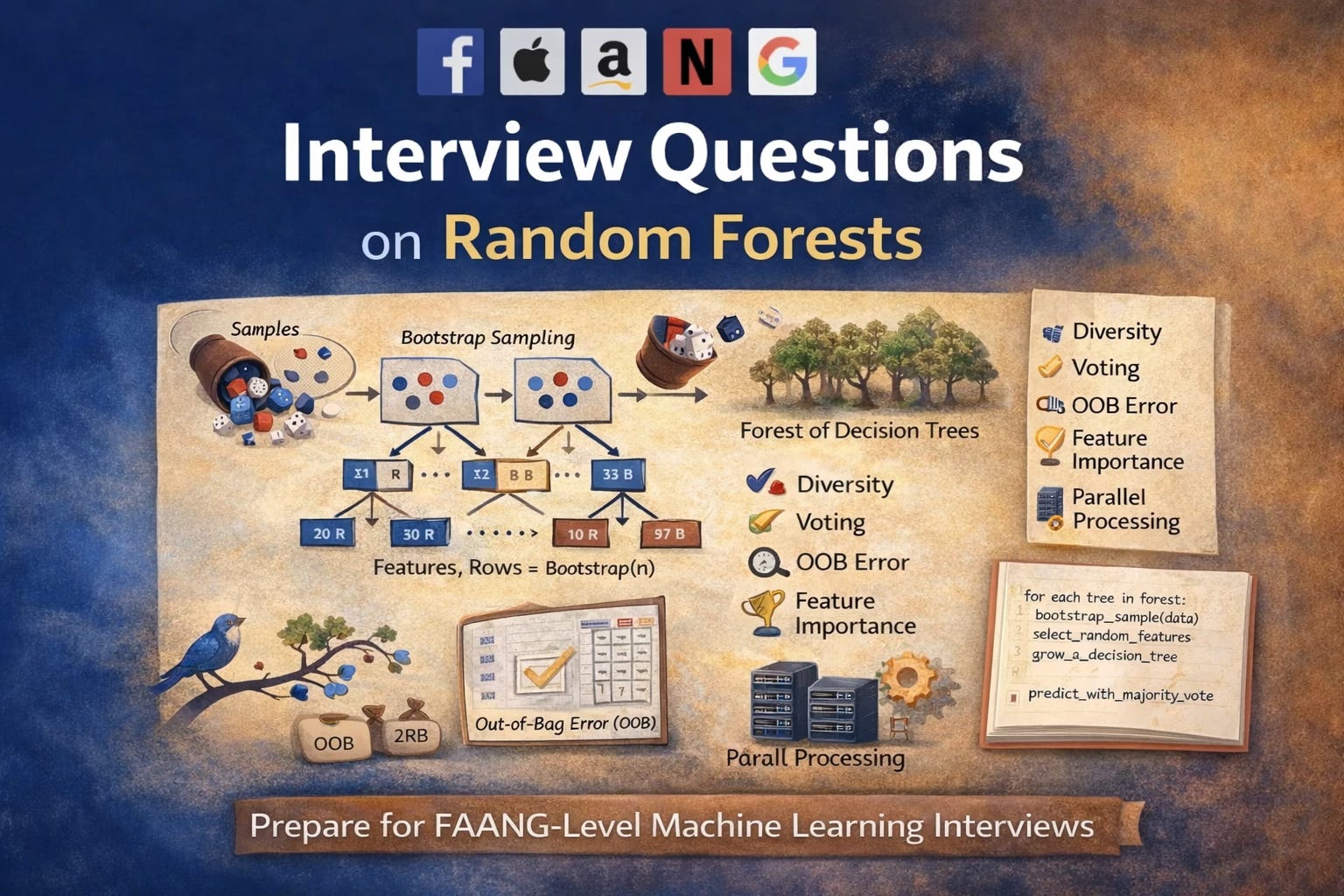
This post curates and answers medium to hard Random Forest interview questions that have been repeatedly asked in real interviews. Each answer is structured to help you think like an interviewer expects, focusing on clarity, depth, and practical understanding rather than memorization.
Q1: How does Random Forest build its trees, and why does it perform better than a single Decision Tree?
How trees are built
Random Forest trains many decision trees independently using two sources of randomness:
Bootstrap sampling (row randomness)
Each tree is trained on a random sample with replacement from the training data.Feature subsampling (column randomness)
At every split, the tree considers only a random subset of features instead of all features.
Why this works better than a single tree
A single decision tree:
Has low bias
But very high variance (small data changes → very different trees)
Random Forest:
Keeps low bias (trees are still deep)
Dramatically reduces variance by averaging many decorrelated trees
Q2: What is bagging, and how is it different from boosting? How is bagging used in Random Forest?
Bagging (Bootstrap Aggregating)
Train models in parallel
Each model sees a bootstrap sample
Final prediction = average / majority vote
Goal: reduce variance
Boosting
Train models sequentially
Each new model focuses on previous errors
Examples: AdaBoost, Gradient Boosting
Goal: reduce bias (and variance)
In Random Forest
Bagging provides data diversity
Feature subsampling provides model diversity
Together they decorrelate trees
Q3: What is Out-of-Bag (OOB) error? How is it computed and why is it useful?
Because of bootstrapping:
Each tree sees ~63.2% of unique samples
Remaining ~36.8% are Out-of-Bag for that tree
How OOB error is computed
For each training sample:
Collect predictions only from trees where the sample was OOB
Aggregate predictions
Compare with true label
Why it’s useful
Acts like free cross-validation
No separate validation set needed
Very close to test error in practice
Q4: What are the key hyperparameters of Random Forest and how do they affect the model?
Some of the key hyperparamters are:
n_estimators
max_depth
min_samples_leaf
max_features
bootstrap
How do they affect?
Deeper trees → low bias, high variance
Fewer features per split → lower correlation
Larger leaf size → regularization
Common defaults (classification):
max_features
= sqrt(d)Deep trees + many estimators
Q5: How does Random Forest handle missing values?
Standard Random Forest implementations (e.g., scikit-learn) do NOT natively handle missing values. You must handle them explicitly.
1. Pre-imputation (most common)
Mean/median (numerical)
Mode (categorical)
Model-based imputation
2. Indicator variables
Add a binary feature: Lets trees learn “missingness” itself as a signal.
3. Surrogate splits (theoretical)
Used in CART
If primary split feature is missing, use correlated feature
Not widely implemented in RF libraries
Q6: How is feature importance computed in Random Forest?
Random Forest provides two widely used notions of feature importance, each answering a slightly different question.
Impurity-Based (Gini) Importance
During training, every split reduces node impurity (Gini or entropy).
For each feature, Random Forest sums this impurity reduction across all trees:
This measures how frequently and how effectively a feature is used.
Advantages
Extremely fast
Available immediately after training
Limitations
Biased toward high-cardinality features
Inflates importance of correlated features
Permutation Importance
Permutation importance answers a stronger question:
How much does the model actually rely on this feature?
The process is simple:
Measure baseline model performance
Randomly shuffle one feature
Measure performance drop
\(\text{Importance}(f) = \text{Perf}_{\text{original}} - \text{Perf}_{\text{shuffled}} \)
Advantages
Model-agnostic
Reflects true predictive dependency
Limitations
Computationally expensive
Still unstable with correlated features
Q7. Random Forest achieves perfect training accuracy but poor validation accuracy. What went wrong?
This situation indicates overfitting, driven primarily by high variance. Although Random Forest reduces variance compared to a single decision tree, it does not eliminate it.
Common causes
Trees are too deep (max_depth too large)
Leaves are too small (min_samples_leaf too low)
Dataset is small or noisy
Feature leakage from target into inputs
Too few trees to average out noise
How to fix it
Increase min_samples_leaf
Limit max_depth
Increase n_estimators
Monitor Out-of-Bag error
Use permutation importance to detect leakage
Key insight:
Random Forest controls variance through averaging but if each tree memorizes noise, the ensemble still overfits.
8. How does Random Forest handle categorical variables? What preprocessing is required?
In theory, decision trees can split directly on categorical features. In practice, most Random Forest implementations expect numeric inputs.
Common encoding strategies
One-Hot Encoding
Safe and robust
Increases dimensionality
Random Forest handles sparsity well
Ordinal Encoding
Risky when no true order exists
Can introduce artificial hierarchy
Target / Mean Encoding
Powerful for high-cardinality features
Must be cross-validated to avoid leakage
Q9. Why does a bootstrap sample contain ~63.2% of unique data points?
For a dataset of size N:
Probability a sample is not selected in one draw:
\(1-1/N\)Probability it is never selected in N draws:
\((1-1/N)^N\)As N→∞:
\(\lim_{N \to \infty} \left(1 - \frac{1}{N}\right)^N = e^{-1} \approx 0.368 \)
So:
36.8% of samples are Out-of-Bag
63.2% appear at least once
Q10. How does node impurity choice (Gini vs Entropy) affect Random Forest performance?
Gini Impurity
Faster to compute
Favors dominant classes
Default in most implementations
Entropy
More sensitive to class balance
Encourages purer splits
Computationally heavier
In practice
For Random Forests:
Difference is usually negligible
Tree randomness dominates behavior
Depth, data quality, and feature randomness matter more
Q11: How can Random Forest measure similarity between observations? How is this useful for unsupervised tasks?
Random Forest can compute a proximity (similarity) matrix between samples, even though it is primarily a supervised algorithm.
How proximity is defined
Two samples are considered similar if they land in the same leaf node of a tree.
Proximity between samples i and j is the fraction of trees in which they share a leaf.
\(\text{Proximity}(i, j) = \frac{1}{T} \sum_{t=1}^{T} \mathbb{1} \big( \ell_t(x_i) = \ell_t(x_j) \big) \)
Proximity helps in
Captures nonlinear similarity
Uses feature interactions learned by trees
No explicit distance metric needed
Applications
Clustering using proximity matrix
Outlier detection (low average proximity)
Visualization via MDS or t-SNE
Q12. How does Random Forest handle correlated features? Does correlation matter?
Correlation matters but less than you might expect.
What happens with correlated features
Correlated features compete for splits
Importance gets shared or diluted
One feature may dominate early splits
Why Random Forest is robust
Feature subsampling ensures correlated features don’t always compete
Different bootstrap samples cause different features to win splits
Averaging across trees stabilizes predictions
What still breaks
Feature importance becomes unreliable
Permutation importance underestimates correlated features
Q13. How can Out-of-Bag predictions be used to estimate uncertainty or confidence intervals?
Random Forest naturally supports uncertainty estimation through its ensemble structure.
Key idea
Each sample receives predictions from a subset of trees (those where it is OOB).
Regression
Use distribution of OOB predictions
Estimate variance or quantiles
Classification
Use vote proportions
Predictive confidence ≈ vote entropy
Why this matters
Confidence-aware predictions
Risk-sensitive decision systems
Model debugging
Q14. What are the trade-offs in parallelizing Random Forest training?
Random Forest is embarrassingly parallel, but trade-offs still exist.
What parallelizes well
Tree construction
Bootstrap sampling
Feature selection
What doesn’t
Memory bandwidth
Aggregation overhead
I/O bottlenecks
Q15. How would you tune and evaluate Random Forest on a highly imbalanced dataset?
Key challenges
Accuracy becomes meaningless
Minority class is under-represented
Default splits favor majority class
Model-level strategies
class_weight
=balancedIncrease min_samples_leaf
Reduce max_depth
Data-level strategies
Stratified sampling
SMOTE or undersampling
Cost-sensitive learning
Evaluation metrics
Precision–Recall AUC
F1 score
Recall at fixed precision
Q16. How would you deploy a Random Forest model for real-time predictions? What ensures low latency and scalability?
Random Forest deployment is often simpler than deep models, but careful system design is still required for real-time use.
Key challenges
Large number of trees
Memory-heavy models
Latency grows linearly with tree count
Best practices
Limit tree depth to reduce inference time
Serialize efficiently (e.g., joblib, ONNX where applicable)
Warm-load models in memory (no disk access at inference)
Batch predictions when possible
Horizontal scaling using stateless services
Production architecture
Feature preprocessing as a shared service
Model served behind REST/gRPC
Cache frequent predictions if feature space is stable
Conclusion
Random Forest interviews are rarely about remembering definitions. They are about demonstrating that you understand why ensembles work, how randomness reduces correlation, and how these ideas affect performance, interpretability, and deployment at scale.
If you can confidently explain concepts like bootstrap sampling, Out-of-Bag error, feature importance bias, proximity measures, and system trade-offs, you are already operating at a strong interview level. These are the signals interviewers look for when assessing whether someone can move beyond toy datasets and build robust models in production.
This post is part of a broader effort to create deep, interview-focused explanations the kind that help you reason under pressure rather than recite answers.
To explore more interview-ready machine learning concepts and deep dives, please follow the link below: Interview Prep